
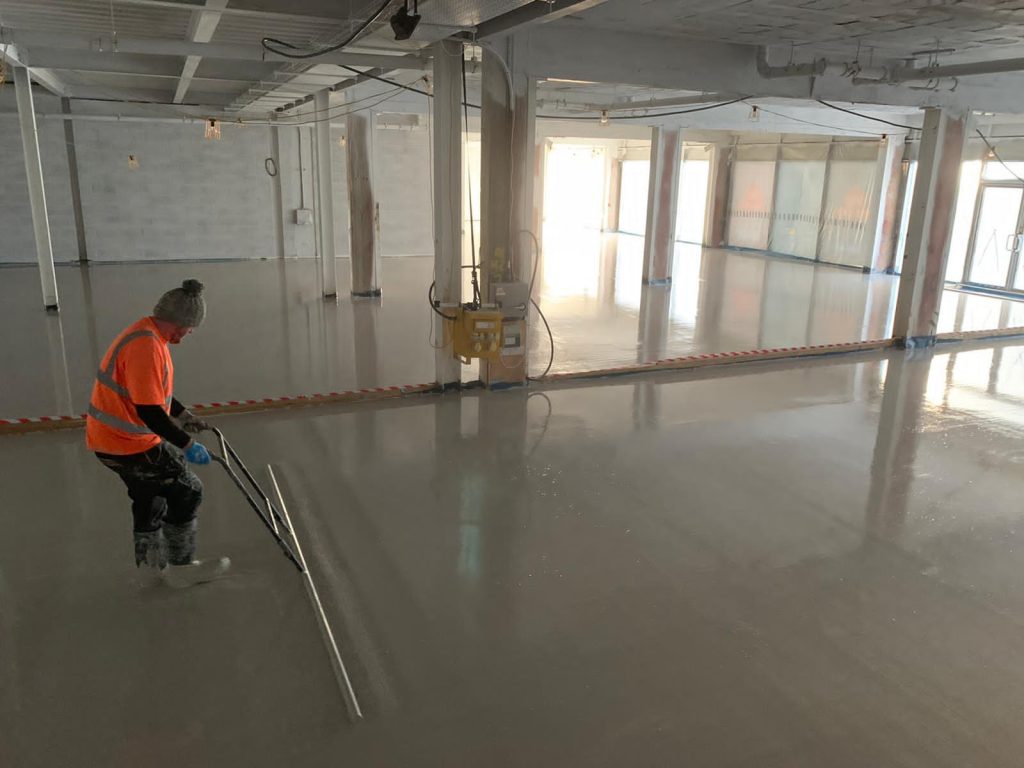
If you are in the early stages of a build or renovation and trying to work out what your floor needs, you have probably come across both options. Concrete and screed are not interchangeable, and using the wrong one in the wrong place causes problems that are expensive to fix. This guide explains the difference between the two, what each is used for, and how to decide which is right for your project.
What is the Difference Between Screed and Concrete?
Concrete and screed are both cementitious or calcium sulphate-based materials used in floor construction, but they serve very different purposes and sit at different levels in the floor build-up.
Concrete is a structural material. It is made from cement, aggregates, and water, and its job is to carry load — the weight of the building, the people in it, and everything on the floor. A concrete slab is typically the first layer laid directly onto the ground or a suspended structure. It is dense, strong, and not designed to be a finished surface.
Screed is a finishing layer laid on top of the structural slab. Its job is to create a smooth, level surface ready to accept the final floor covering — tiles, wood, vinyl, carpet, or polished concrete. Screed is not load-bearing in the same way concrete is, but it needs to be durable enough to handle foot traffic and the stresses of a heating and cooling cycle if underfloor heating is present.
In most floor constructions, you need both: concrete provides the structure, screed provides the surface.
When Do You Need Concrete?
Concrete is required wherever structural strength is the priority:
- Ground-bearing slabs: The main floor slab poured directly onto a prepared sub-base, typically the first step in any new build ground floor
- Oversite concrete: A layer poured across the ground inside a building’s footprint before insulation and screed are laid
- Foundations: Strip, pad, or raft foundations all use concrete
- External areas: Driveways, paths, hardstandings, and outbuildings
If you are building from the ground up, you will need concrete before screed becomes relevant. Ready2Pour supply ready mixed concrete alongside our screed services, so both can be sourced from a single supplier.
When Do You Need Liquid Screed?
Once your structural slab is in place, liquid floor screed is what creates the finished floor surface. It is the right choice when:
- You are laying floor coverings over an existing or newly poured concrete slab
- You are installing underfloor heating and need a screed that fully encapsulates the pipes
- You need a large, flat floor area covered quickly
- You are working in a renovation where floor height is a constraint and a thin-section screed is needed
- You want a self-levelling finish without manual tamping
Liquid screed is not suitable as a structural base. It is too thin and not formulated to carry the loads that a concrete slab handles.
Liquid Screed vs Concrete: A Direct Comparison
| Liquid Screed | Concrete | |
| Primary purpose | Finishing layer: flat, level surface for floor coverings | Structural layer: load-bearing slab or foundation |
| Typical depth | 30 to 65 mm | 100 to 300 mm+ |
| Self-levelling | Yes | No |
| Suitable for UFH | Yes, excellent | No |
| Surface finish | SR2 or better as standard | Rough unless power-floated |
| Installation speed | Up to 2,000 m2 per day | Slower, weather-dependent curing |
| Used as a finished floor | Rarely | Sometimes (industrial settings) |
| Position in floor build-up | Above the structural slab | Below everything else |
Can You Use Concrete Instead of Screed?
This is one of the most common questions, and the honest answer is: technically yes, but rarely a good idea.
Concrete can be power-floated to create a relatively smooth surface, and in some industrial or agricultural settings this is used as a finished floor. But for most residential and commercial applications, concrete on its own is not flat enough or smooth enough to lay floor finishes directly onto. It also does not perform well over underfloor heating pipes – it is too thick, too heavy, and not formulated for the thermal cycling that a UFH system puts it through.
Liquid screed, on the other hand, is self-levelling, achieves a much flatter finish, can be laid at much thinner depths, and is specifically formulated for the demands of modern floor construction.
Can You Use Screed Instead of Concrete?
No. Screed is not a structural material and should never be used in place of a concrete slab. It does not have the compressive strength or depth to carry building loads, and laying screed directly onto the ground without a concrete base will result in failure.
Which Do You Need for Your Project?
For most projects, the answer is both, at different stages:
- New build: Concrete slab first, then screed once insulation and any underfloor heating pipes are in place.
- Renovation over an existing slab: Screed only, laid over the existing concrete once the surface has been prepared.
- Extension: Concrete oversite or suspended slab, then screed above.
- Industrial floor where no covering is needed: Concrete, power-floated to a smooth finish.
If you are unsure which is right for your specific situation, the Ready2Pour team can advise. We handle both screed supply and installation across Hertfordshire, Essex, Cambridgeshire, Greater London, Bedfordshire and Buckinghamshire, alongside ready mixed concrete for projects that need both.
Screed depth
More material means a higher cost, so the depth you need directly affects the total liquid screed price. Depth is determined by your floor build-up: whether you are on insulation, over underfloor heating pipes, bonded to a substrate or working to a tight floor height.
Product choice
Not all liquid screeds cost the same. The Gyvlon range covers several products at different price points, from the general-purpose Gyvlon ECO through to specialist formulations like Gyvlon THERMIO MAX, which offers higher thermal conductivity for underfloor heating applications, and Gyvlon EXCELIO, which can be bonded at just 8 mm.
Supply only or supply and installation
If you have your own screeding team and are buying screed to be delivered to site, you are looking at a supply-only cost. If you want Ready2Pour to handle the installation as well, the installation cost is added on top.
Pump hire
For sites where the delivery vehicle cannot get close to the pour area,or where screed needs to reach an elevated floor, liquid screed pump hire adds to the overall cost. Our pumps reach up to 100 metres from the vehicle, but if your project requires this, it is worth factoring into your budget from the outset.
Access and location
Site access affects cost. A straightforward ground-floor pour with good vehicle access is simpler and cheaper to service than a multi-storey site with restricted entry. Location within our service area also plays a role in delivery pricing, though Ready2Pour cover Hertfordshire, Essex, Cambridgeshire, Greater London, Bedfordshire and Buckinghamshire from our base in Bishop’s Stortford, so most projects in these regions are well within a standard delivery zone.
Is Liquid Screed More Expensive Than Sand and Cement?
The material cost of liquid screed is typically higher per tonne than sand and cement screed, but this comparison rarely tells the whole story.
When you factor in installation speed – liquid screed can cover up to 2,000 m2 per day compared to around 150 to 200 m2 for sand and cement – the labour cost per square metre is significantly lower. The faster a floor is down, the sooner the next trade can start, which on a time-sensitive project has a real commercial value.
Liquid screed also requires fewer movement joints and is far less prone to cracking than sand and cement, which reduces remediation costs. And for projects with underfloor heating, the improved thermal conductivity of a product like Gyvlon THERMIO MAX means the heating system runs more efficiently over the life of the building, delivering ongoing savings on energy bills.
So while the upfront liquid screed price can be higher, the total cost across a project is often comparable or lower.
What is Included in a Liquid Screed Quote?
At Ready2Pour, our quotes are transparent and based on a precise measurement of your floor area. A typical quote will cover:
- Material cost for the specified Gyvlon product and depth
- Delivery to site
- Installation labour (if a full supply and installation service is requested)
- Pump hire (if required)
We measure every project accurately before quoting, which means you are not left with material shortfall on the day or paying for screed you did not need.
How to Get an Accurate Liquid Screed Price
The best way to get a reliable figure is to have the following ready when you contact us:
- Floor area in m2: An approximate measurement is fine to start with; we will take a precise measurement before the quote is finalised
- Screed depth required: If you are unsure, tell us about your floor build-up and we can advise
- Whether you need supply only or supply and installation
- Site access details: Is the vehicle able to get close to the pour area or will pump hire be needed?
- Your location and preferred delivery window
From there we can turn around a quote quickly. We offer screed supply and full installation across our service area, and our team will advise on the right product for your project as part of the quoting process. You can find out more about our liquid floor screed services or get in touch.
Common Questions About Liquid Screed vs Concrete
Is screed stronger than concrete?
No. Concrete is significantly stronger in compression and is designed to carry structural loads. Screed is designed for flatness, surface quality, and compatibility with floor coverings rather than structural strength.
How thick does screed need to be over concrete?
It depends on the screed type and what is below it. For a floating liquid screed installation over insulation with underfloor heating, the minimum total depth is typically 30 mm. For a bonded installation directly onto a concrete slab, it can be as little as 20 mm with a specialist product. The team at Ready2Pour can advise on the right depth for your build-up.
Can liquid screed be laid directly onto concrete?
Yes, in a bonded installation. The concrete surface needs to be mechanically prepared first to ensure adhesion, and a primer is typically applied before the screed is poured.
How long after concrete is poured can screed be laid?
Concrete needs to be structurally cured before screed goes on top. As a general guide this is at least 28 days, though the exact timing depends on the concrete mix, slab thickness, and site conditions. Your structural engineer or concrete supplier can advise on the specific curing period for your project.
Do I need both concrete and screed for a new build?
In most cases, yes. The concrete slab provides the structural base, and the screed goes on top to create a flat, level surface for your floor coverings. They are separate products doing separate jobs at different stages of the build. Ready2Pour can supply both, so if your project needs concrete and screed, you can source everything from one place.
Get a Quote from Ready2Pour
Ready2Pour are liquid screed specialists based in Bishop’s Stortford, covering projects across Hertfordshire, Essex, Cambridgeshire, Greater London, Bedfordshire and Buckinghamshire. We supply and install BBA-approved Gyvlon screeds and offer transparent, accurate quotes based on your project specifics.
Get in touch for a free quote.