
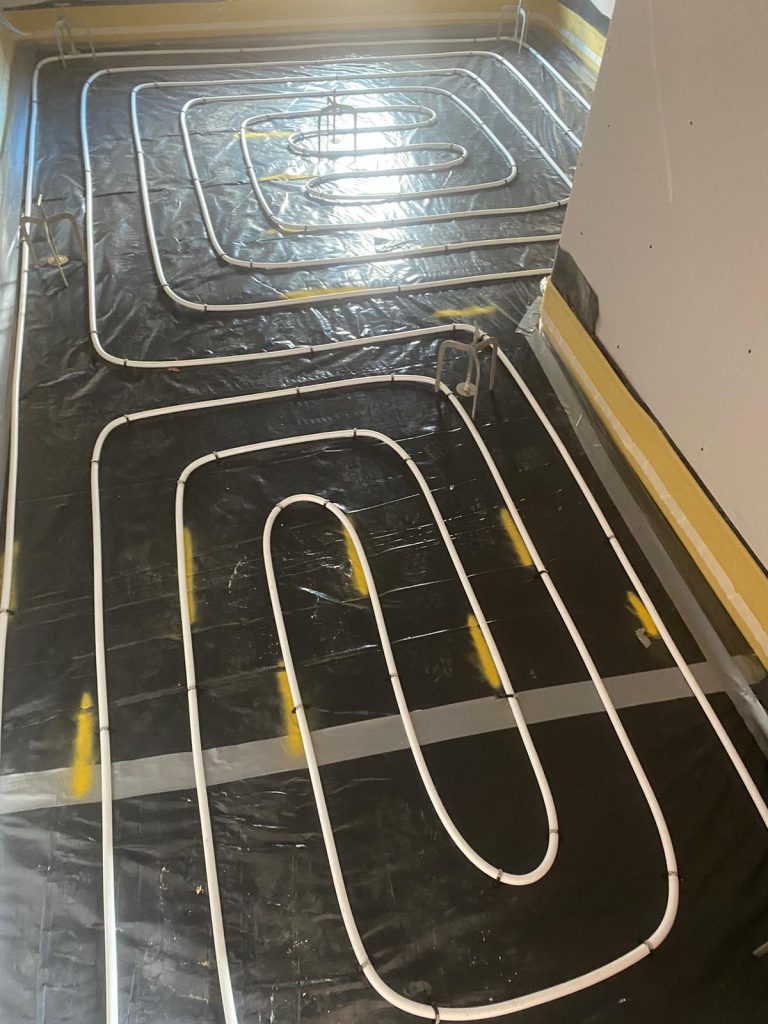
If you are planning an underfloor heating system, one of the most important decisions you will make is which screed to use. The screed is not just a surface layer; it is the medium through which the heat from your pipes travels up into the room. Get this wrong and you end up with a system that is slow to respond, inefficient or costly to run. Get it right and you have a floor that heats evenly, quickly and cheaply.
The short answer is yes: liquid screed is widely regarded as the best screed for underfloor heating. And for projects where thermal performance is the priority, there is one product that stands above the rest: Gyvlon THERMIO MAX. This guide explains why liquid screed works so well over underfloor heating, what depth you need and which product Ready2Pour recommends.
Why Liquid Screed Works Better Over Underfloor Heating
The job of the screed in a UFH system is to sit above the pipes and transfer heat from them up through the floor. For that to work well, the screed needs to be in close, consistent contact with every pipe. This is where liquid screed has a clear advantage.
Because it is pumped and self-levelling, liquid screed flows around the pipes completely, filling every gap without any manual working. Traditional sand and cement screed is laid and compacted by hand, and no matter how experienced the installer, it is very hard to avoid small air pockets forming around the pipes. Those air gaps act as insulation and reduce how efficiently heat transfers from the pipe into the floor.
Liquid screed also conducts heat more effectively than sand and cement, meaning your boiler or heat pump does not need to work as hard to reach the same room temperature. It dries with minimal shrinkage too, so it maintains that close contact with the pipes over time rather than pulling away slightly as it cures.
The practical result is a floor that heats more evenly, responds more quickly when you adjust the thermostat, and costs less to run.
The Best Screed for Underfloor Heating: Gyvlon THERMIO MAX
For projects where the underfloor heating system needs to perform at its best, Ready2Pour recommend Gyvlon THERMIO MAX. It is the product in the Gyvlon range specifically formulated for UFH applications, and it goes further than a standard liquid screed on the things that matter most.
THERMIO MAX uses COOL-TEC technology to achieve a higher thermal conductivity than standard liquid screed, meaning heat moves through the floor faster and more efficiently. The manufacturer’s data shows it can deliver up to 20% savings on heating bills compared to a conventional screed. It is particularly well suited to heat pump installations, where running at lower flow temperatures is key to efficiency – the better the screed conducts heat, the harder the pump does not have to work.
It also incorporates fast-drying technology, so floor coverings can go down sooner than with a standard product. For new build programmes where time between trades matters, this is a useful advantage.
The full technical datasheet is available to download on the Gyvlon THERMIO MAX product page.
What Depth Does Screed Need to Be Over Underfloor Heating?
This is one of the most common questions on UFH projects, and it is worth getting right. Too thin and you risk cracking or inadequate coverage over the pipes. Too thick and you add unnecessary weight and increase the time it takes for heat to reach the surface.
For Gyvlon THERMIO MAX over underfloor heating, the guidelines are:
- Floating installation (screed laid over insulation with pipes fixed on top): minimum 30 mm total depth for residential, 35 mm for commercial
- Bonded installation (screed fixed directly to the substrate): minimum 20 mm for residential, 25 mm for commercial
These are thinner than the depths typically required for standard liquid screeds or sand and cement, which is another advantage of THERMIO MAX – its higher thermal conductivity means you do not need as much material to achieve the same performance.
For a traditional sand and cement screed over UFH, a minimum of 65 to 75 mm is typically recommended in a floating installation – considerably more material, more weight, and a slower system to respond.
How much screed will you need?
Volume depends on floor area, depth, and substrate variation. As a rough guide, 100 m2 at 50 mm depth requires around 5 m3 of screed, plus 10 to 15% for waste and variation. Ready2Pour measure every project before supply or installation to give you an accurate figure. Get in touch today for your free quote.
Liquid Screed vs Sand and Cement Over Underfloor Heating
Getting the depth right is one of the most common questions on UFH projects. The correct depth depends on whether the installation is floating (screed over insulation) or bonded (screed fixed to the substrate), and on the specific product used.
| Gyvlon THERMIO MAX | Sand and Cement | |
| Pipe encapsulation | Complete | Risk of air voids |
| Heating efficiency | Up to 20% savings vs standard screed | Baseline |
| Minimum depth (floating, residential) | 30 mm | 65 to 75 mm |
| Heat pump compatibility | Excellent | Moderate |
| Shrinkage | Negligible | Higher risk |
| Fast drying | Yes | No |
Frequently Asked Questions About Liquid Screed for Underfloor Heating
Can you turn underfloor heating on straight after screeding?
No. Wait at least 7 days before starting the commissioning process, then increase the flow temperature gradually over several days. Running the system at full temperature immediately after installation can cause cracking.
How long before floor finishes can go down?
Tiles and vinyl can typically be laid once the screed reaches 1% residual moisture, and carpets from 2%. Running the underfloor heating system during commissioning accelerates this process. Most projects reach the required moisture level within 4 to 6 weeks.
Does liquid screed crack over underfloor heating?
It is much less prone to cracking than sand and cement, as calcium sulphate screeds shrink very little as they dry. Some surface crazing is normal and does not affect performance. Fitting perimeter insulation strip before pouring and following the correct commissioning protocol both help prevent more significant cracking.
Is liquid screed compatible with all underfloor heating systems?
Yes. It works with all wet UFH systems, whether connected to a gas boiler, air source heat pump, or ground source heat pump.
Get a Quote from Ready2Pour
Ready2Pour are liquid screed specialists based in Bishop’s Stortford, covering projects across Hertfordshire, Essex, Cambridgeshire, Greater London, Bedfordshire and Buckinghamshire. We supply and install Gyvlon THERMIO MAX and the full BBA-approved Gyvlon range, and can advise on the right product for your underfloor heating project.
Whether you need screed supplied to your site or a complete supply and installation service, get in touch for a free quote.