
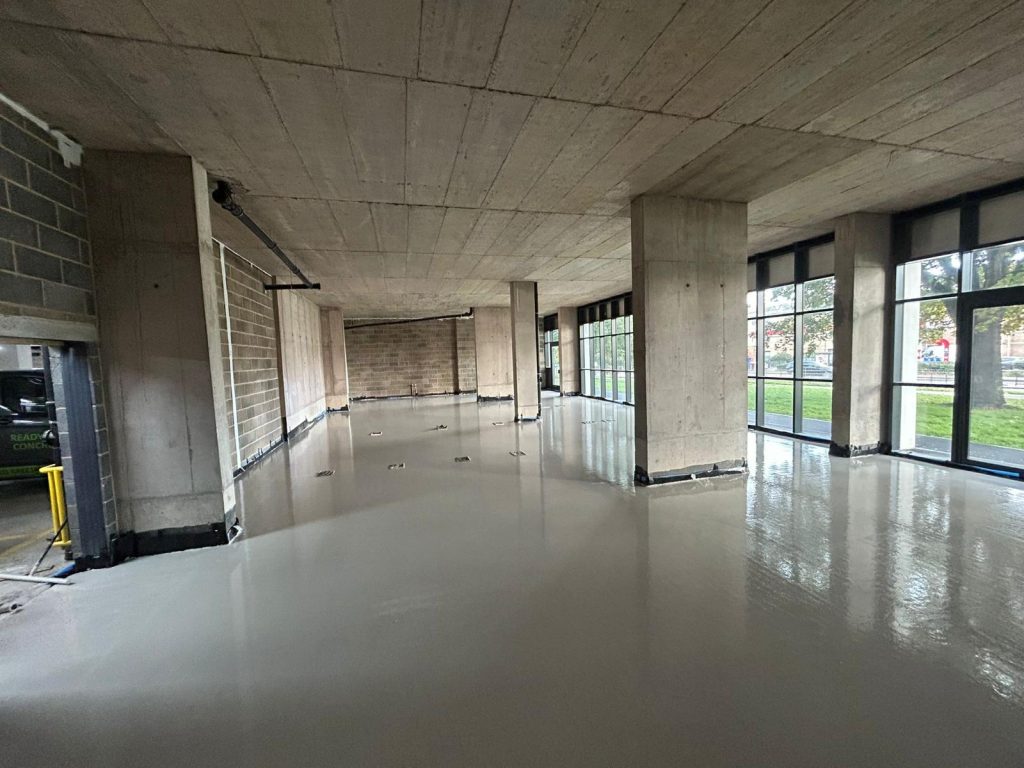
If you’ve recently been quoted for a new floor build-up or underfloor heating system, there’s a good chance the word screed came up and, more specifically, liquid screed. But what exactly is it, how does it work, and why are contractors and builders increasingly choosing it over traditional sand and cement? This guide covers everything you need to know.
What Is Screed?
Screed is a layer of material, typically a cementitious or calcium sulphate mix, applied over a structural concrete slab or substrate to create a smooth, level surface ready for floor finishes such as tiles, wood, vinyl, or polished concrete.
In simple terms, screed is the layer between your structural floor and your finished floor. It carries the load, encapsulates underfloor heating pipes, accommodates insulation, and provides a flat, even surface for the final covering.
Screed is used across residential new builds, commercial developments, renovations, extensions, and industrial projects. Essentially, anywhere a level, durable floor base is required.
What Is Liquid Screed?
Liquid screed, also known as liquid floor screed, flowing screed, or calcium sulphate screed, is a pumpable, self-levelling floor compound that flows into place rather than being manually laid and tamped like traditional sand and cement screed.
Unlike conventional screed, which requires skilled operatives to manually mix, spread, and compact the material by hand, liquid screed is pumped directly from a truck or mixing unit into the floor zone, where it flows freely around underfloor heating pipes and insulation, self-levelling to a flat, consistent finish under gravity.
The result is a faster installation, a more accurate level, and a surface that performs significantly better, particularly over underfloor heating systems.
What Is Liquid Screed Made Of?
Liquid screed is primarily a calcium sulphate (anhydrite) based product, composed of:
- Anhydrite binder: A calcium sulphate compound that acts as the binding agent, replacing traditional Portland cement. At Ready2Pour, the Gyvlon screeds we supply use a binder made from up to 98% recycled materials, making it one of the most sustainable options available.
- Fine aggregates: Typically fine sand or limestone fines, graded for flowability and strength.
- Water: Precisely metered to achieve the correct flow consistency and working properties.
- Admixtures: Chemical additives that control flow, working time, and early strength gain depending on the specific product grade.
Some specialist liquid screeds, such as Gyvlon EXCELIO®, are formulated for ultra-thin applications and use a proprietary technology that bridges the gap between traditional flowing screeds and self-smoothing compounds, achieving a bonded thickness of just 8 mm.
It is worth noting that cement-based flowing screeds also exist, but calcium sulphate screeds dominate the UK market due to their superior performance, thinner sections, and greater compatibility with underfloor heating.
What Is Liquid Screed Used For?
Liquid floor screed is suitable for a wide range of applications:
Underfloor heating systems: This is where liquid screed truly excels. Its self-levelling nature means it flows around and fully encapsulates underfloor heating pipes without air voids, dramatically improving thermal conductivity and heating efficiency. Traditional sand and cement screed can leave air pockets around pipes, reducing their effectiveness.
New build residential projects: Liquid screed is the go-to choice for house builders seeking fast installation, consistent quality, and minimal disruption between trades.
Renovations and extensions: Whether reflooring a ground floor extension or laying over an existing slab, liquid screed provides a fast, accurate solution with minimal build-up depth.
Commercial and industrial floors: Large open areas such as warehouses, offices, schools, and retail units benefit enormously from liquid screed’s speed of installation. Up to 2,000 m² per day is achievable.
Renovation over existing substrates: Products such as Gyvlon EXCELIO® can be bonded at just 8 mm, making them ideal for renovation projects where floor height is a constraint and build-up must be kept to an absolute minimum.
The Key Benefits of Liquid Screed
1. Self-levelling
Liquid screed flows under gravity to produce a naturally flat, level surface. This eliminates the need for manual tamping and screeding boards, and removes the risk of high or low spots caused by human error. Most liquid screeds achieve an SR2 surface finish as standard, with SR1 achievable with specialist products.
2. Superior underfloor heating performance
Liquid screed encapsulates underfloor heating pipes completely, eliminating air voids. This makes the thermal mass of the screed work more efficiently, allowing your boiler or heat pump to operate at lower flow temperatures, reducing energy bills and improving system efficiency. For heat pump systems in particular, this compatibility is increasingly important for meeting energy performance standards.
3. Faster installation
A professional liquid screed crew can install up to 2,000 m² per day, compared to around 150 to 200 m² per day with traditional sand and cement screed. For time-sensitive projects, this difference is significant.
4. Reduced build-up depth
Liquid screeds can be installed at thinner sections than traditional screed, particularly over insulation and underfloor heating. This is especially valuable in renovation projects where every millimetre of floor height matters. Products like Gyvlon EXCELIO® can be bonded at just 8 mm, with no site mixing or storage required.
5. No shrinkage cracking
Calcium sulphate liquid screeds undergo minimal shrinkage during curing, which significantly reduces the risk of cracking compared to sand and cement alternatives. This means fewer joints, less post-installation remediation, and a cleaner result.
6. Large bay sizes without expansion joints
Because liquid screed experiences negligible drying shrinkage, it can be laid in very large bays without intermediate movement joints. This simplifies installation considerably in open-plan spaces.
7. Sustainability
The anhydrite binder used in Gyvlon screeds is derived from a by-product of industrial processes, with the binder content comprising up to 98% recycled materials. This dramatically reduces the embodied carbon of the floor build-up compared to Portland cement-based products, an increasingly important consideration as construction projects are assessed against sustainability benchmarks.
8. Consistency and quality control
Because liquid screed is batched and supplied ready-to-use by specialist manufacturers, every delivery meets a certified standard. There is no risk of on-site batching errors, incorrect water-to-cement ratios, or variable aggregate proportions. All Gyvlon screeds supplied by Ready2Pour carry BBA (British Board of Agrément) approval, providing full confidence in performance.
How Is Liquid Screed Installed?
The installation process for liquid floor screed is straightforward, but preparation is key to a successful result. Here is what a typical installation involves:
1. Substrate preparation: The base slab or substrate must be structurally sound, clean, and free from debris. For bonded applications, the surface is mechanically prepared to ensure adhesion.
2. Insulation and UFH installation: If underfloor heating is being installed, the pipes are laid and pressure-tested before screeding begins. Insulation boards are fixed in place.
3. Edge insulation: Perimeter insulation strip is fitted around the edges of the room to allow for thermal movement.
4. Pumping: Liquid screed is pumped directly from the truck or mixing unit through a hose into the floor zone. The material flows freely to fill the space.
5. Dappling: The installer dapples the wet screed with a pole to release any trapped air bubbles and ensure full encapsulation of UFH pipes.
6. Curing: The screed is left to cure with doors and windows closed to prevent drafts. A typical liquid screed is foot-traffickable within 24 to 48 hours.
7. Priming and drying: Before floor finishes are laid, the screed must reach the appropriate residual moisture content (typically below 0.5% for calcium sulphate). Forced drying by running the UFH system at low temperatures can accelerate this.
Ready2Pour handles the entire process from screed supply through to professional installation, ensuring a consistent result and a single point of accountability on your project.
Which Type of Liquid Screed Do I Need?
Not all liquid screeds are the same. The right product depends on your project type, build-up constraints, programme, and sustainability requirements. Ready2Pour supplies the full Gyvlon range from Anhydritec®:
- Gyvlon ECO: The most versatile general-purpose screed, compatible with most thermal and acoustic insulations.
- Gyvlon ECO FD E2C: Fast-drying formulation for projects with demanding programme requirements.
- Gyvlon XTR: A high-strength, thin-section option combining mechanical performance with flexibility.
- Gyvlon THERMIO MAX: Specifically formulated to maximise thermal conductivity over underfloor heating, improving heat pump and boiler efficiency.
- Gyvlon FINIO: Ultra-thin, lightweight option ideal for renovation projects with tight floor height constraints.
- Gyvlon EXCELIO®: The most technically advanced option, achievable at just 8 mm bonded with no site mixing required, and the lowest carbon content in the range.
Our team can advise on the right product for your specific project. Get in touch for a free quote.
Frequently Asked Questions About Liquid Screed
How long does liquid screed take to dry?
Liquid screed is typically foot-traffickable within 24 to 48 hours of installation. It is considered suitable for loading (furniture, materials) after around 7 days, and fully dried for floor coverings once residual moisture falls below 0.5% CM, usually within 4 to 6 weeks depending on thickness, temperature, and ventilation. Running an underfloor heating system at graduated temperatures can accelerate this.
Can liquid screed be used over underfloor heating?
Yes, and it is widely regarded as the best screed for underfloor heating applications. Its self-levelling properties ensure full encapsulation of pipes, eliminating air voids that reduce thermal efficiency.
Is liquid screed suitable for renovation projects?
Yes. Thin-section products such as Gyvlon EXCELIO® (bonded from just 8 mm) and Gyvlon FINIO® make liquid screed a viable option for renovation projects where floor height is a constraint.
Does liquid screed crack?
Calcium sulphate liquid screeds have very low shrinkage and are far less prone to cracking than traditional sand and cement screed. Surface crazing is normal and does not affect structural integrity.
How much does liquid screed cost?
Cost depends on the product, area, thickness, and access requirements. Ready2Pour provides transparent, competitive quotes. Contact us here for a no-obligation price.
What floor finishes can go over liquid screed?
Tiles, stone, engineered wood, LVT, vinyl, carpet, and polished concrete can all be laid over liquid screed once it has reached the required moisture content. Always check the adhesive manufacturer’s compatibility recommendations for calcium sulphate substrates.
Why Choose Ready2Pour for Liquid Screed?
Ready2Pour are liquid screed specialists based in Bishops Stortford, supplying and installing BBA-approved Gyvlon screeds across residential and commercial projects. We offer:
- Same-day and next-day delivery across our service area
- Supply and installation under one roof, with no coordination headaches
- Precision measurement to eliminate material waste
- The full Gyvlon range, the right product for every project
- 98% recycled binder with industry-leading sustainability credentials
- Personal service, dealing directly with our team rather than a call centre
Whether you need liquid floor screed supplied, professionally installed, or want to explore our full range of liquid floor screed products, we’re here to help. Get a free quote today.